Tell us about the job
Takes about a minute. No obligation.
A heat pump failing in Cumberland County is more likely a story about age or a poor original install than about what the weather has put it through. 35 severe weather events were recorded in Cumberland County, Illinois between 2015 and 2024. At that rate, severe weather is an occasional event here, not a standing condition, and a contractor working a repair cannot honestly point to storm load as the cause of a worn compressor or a failing reversing valve. What they will look at instead is how long the unit has been running, whether it was sized and charged correctly from the start, and whether it has been serviced. Those are the variables that decide what the repair costs and what gets replaced.
Housing built before the moon landing rarely got its mechanical systems left alone. Successive owners added equipment, swapped units, and patched what failed, which means a heat pump sitting in a house of this vintage may be running on connections and components that accumulated stress across more than one system's lifetime. Half the homes in Cumberland County, Illinois were built in 1970 or earlier (2020-2024 ACS 5-year). A contractor opening a heat pump here has to account for that layered history: whether a contactor or capacitor is at the end of its service life, whether refrigerant lines show the kind of slow degradation that does not trip a fault code until the system stops, and whether the parts the unit takes are still in supply or require sourcing. The age of the building sets the conditions the equipment has been running in, and what the opened unit actually shows determines the repair.
The Parts of a Heat Pump a Contractor Checks First
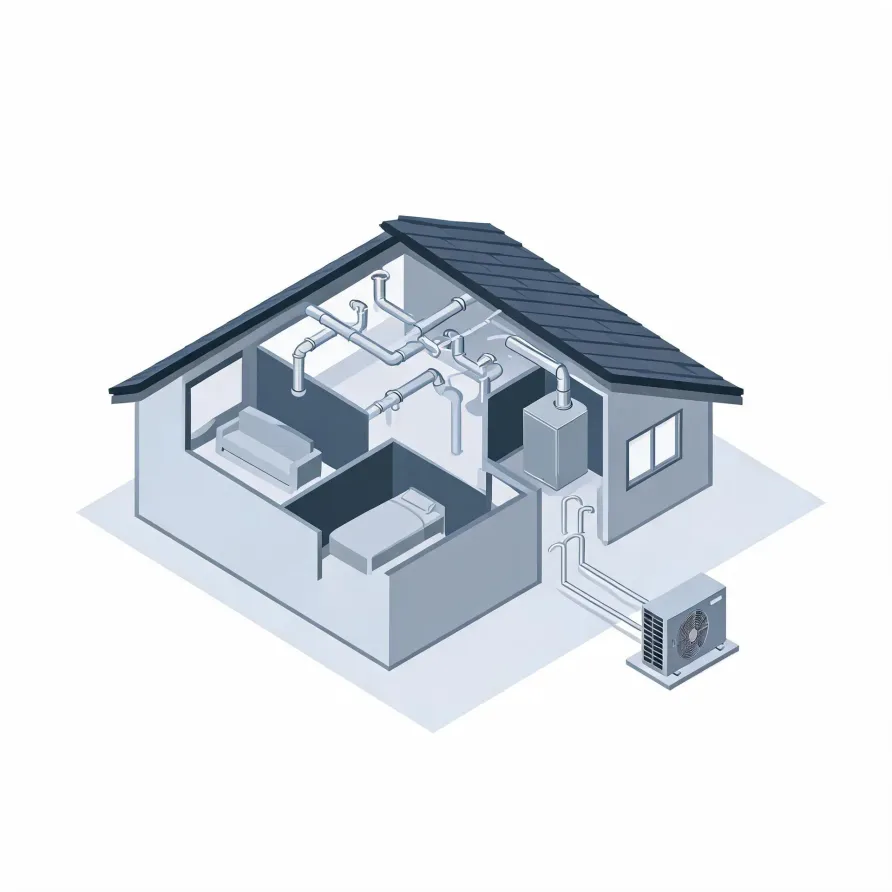
The outdoor unit is where most repair calls begin. It holds the compressor, which moves refrigerant through the system, and the condenser coil, which transfers heat with the outside air. When that unit stops running, makes noise, or ices over, those are the first components a contractor looks at.
Inside the house, the air handler contains the evaporator coil and the blower fan, which pulls air across the coil and pushes conditioned air into the home. The reversing valve, which tells the system whether to heat or cool, sits in the outdoor unit and is a common source of problems when the system runs in only one mode. The expansion valve, which controls refrigerant flow between the two coils, gets checked when temperatures across the system are off.
The drawing shows a typical layout, and a licensed contractor determines which components are relevant to your specific house and system.
Get matched in Cumberland CountyCumberland County by the Numbers
35 severe weather events were recorded in Cumberland County, Illinois between 2015 and 2024.
NOAA National Centers for Environmental Information, Storm Events Database, bulk CSV export, events 2015-01-01 through 2024-12-31.Half the homes in Cumberland County, Illinois were built in 1970 or earlier (2020-2024 ACS 5-year).
U.S. Census Bureau, 2020-2024 American Community Survey 5-Year EstimatesCumberland County, Illinois holds 4,726 housing units (2020-2024 ACS 5-year).
U.S. Census Bureau, 2020-2024 American Community Survey 5-Year EstimatesOwners occupy 84.2% of the occupied homes in Cumberland County, Illinois (2020-2024 ACS 5-year).
U.S. Census Bureau, 2020-2024 American Community Survey 5-Year EstimatesCodes & Standards Covering Heat Pump Repair in Cumberland County, Illinois1 sourced rules & standards
Licensing and Legal Requirements in Cumberland County, Illinois
Illinois leaves HVAC licensing to the municipality: state law lets the corporate authorities of each city or village examine, license and regulate heating, air conditioning and refrigeration contractors, and caps the licence fee they may charge at $50 — so who licenses you depends on the town you work in.
Severe Weather Events in Cumberland County
Weather in Cumberland County puts real stress on heat pump systems, which run year-round and bear the load of every temperature swing. How often that stress hits shapes how hard the equipment works and how soon repair needs surface.
35 severe weather events, 2015–2024. Source: NOAA National Centers for Environmental Information, Storm Events Database.