Tell us about the job
Takes about a minute. No obligation.
A heat pump repair in this county starts with a question a contractor has to answer before anything else: what has this system actually been running against? 146 severe weather events were recorded in St. Clair County, Illinois between 2015 and 2024. At that rate, accumulated stress on capacitors, contactors, and refrigerant lines is a real factor in what a contractor finds when they open a unit, not a remote possibility. A system that has been cycling hard through repeated severe weather events may show compressor strain or electrical wear that looks like a single failure but traces back to load built up over many seasons. That distinction changes the repair scope and sometimes the bill.
Ductwork and wiring put in for an earlier generation of equipment have had a long time to accumulate their own condition problems, and a heat pump sitting on top of that history tends to show it inside. Half the homes in St. Clair County, Illinois were built in 1975 or earlier (2020-2024 ACS 5-year). When a technician opens a unit here, what they find in the refrigerant circuit, the contactor, and the coil surfaces reflects that full run of heating and cooling seasons. A repair scope that ignores those interior conditions and prices only the presenting fault often comes back.
The Parts of a Heat Pump a Contractor Checks First
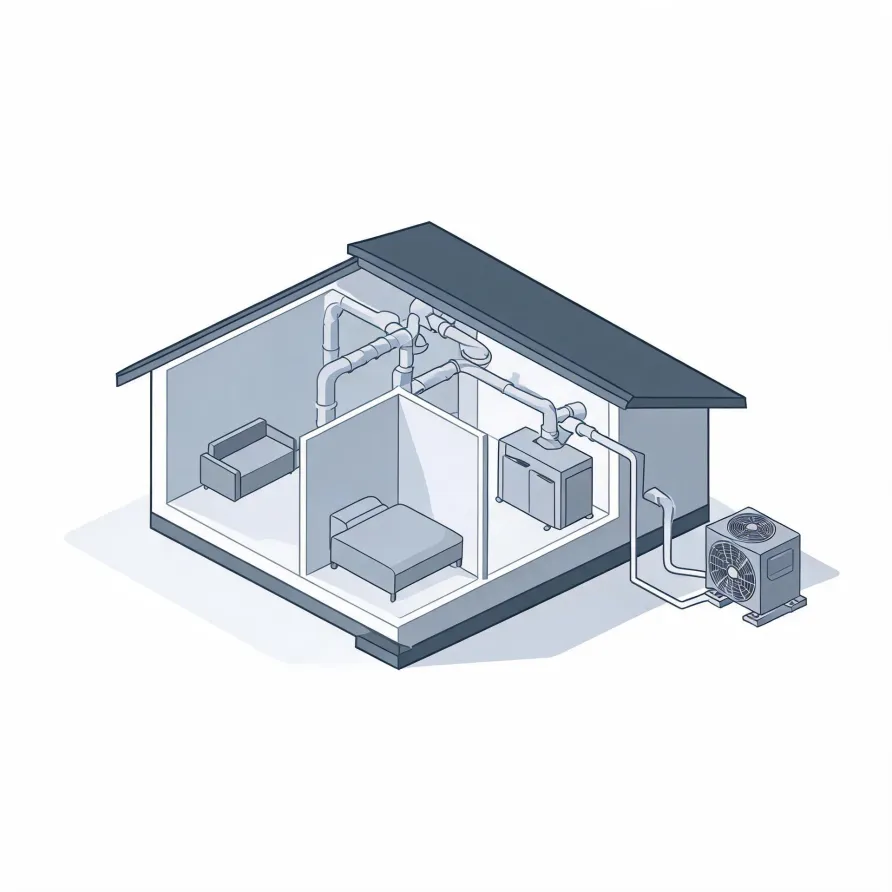
The outdoor unit holds the compressor and the condenser coil, and it sits outside the house on a pad or bracket. The compressor is where a contractor starts when a heat pump loses its ability to move heat: it is the hardest-working component in the system, and a fault there shows up fast. The condenser coil wraps around it, and damage or blockage there is often what a diagnosis turns up.
Inside the house, the air handler contains the blower motor and the evaporator coil, pulling air across the coil and pushing it through the home. The reversing valve sits within the refrigerant loop and is what allows the system to shift between heating and cooling. The expansion valve and refrigerant lines connect the two units, and a slow leak in those lines is something a contractor checks when performance has dropped without an obvious cause.
The drawing beside this text shows a typical layout, and a licensed contractor determines which components and conditions apply to your specific home.
Get matched in St. Clair CountySt. Clair County, by the numbers
146 severe weather events were recorded in St. Clair County, Illinois between 2015 and 2024.
NOAA National Centers for Environmental Information, Storm Events Database, bulk CSV export, events 2015-01-01 through 2024-12-31.Half the homes in St. Clair County, Illinois were built in 1975 or earlier (2020-2024 ACS 5-year).
U.S. Census Bureau, 2020-2024 American Community Survey 5-Year EstimatesSt. Clair County, Illinois holds 115,630 housing units (2020-2024 ACS 5-year).
U.S. Census Bureau, 2020-2024 American Community Survey 5-Year EstimatesOwners occupy 68.4% of the occupied homes in St. Clair County, Illinois (2020-2024 ACS 5-year).
U.S. Census Bureau, 2020-2024 American Community Survey 5-Year EstimatesCodes & Standards Governing Heat Pump Repair in St. Clair County, Illinois1 sourced rules & standards
Licensing Rules for HVAC Work in St. Clair County, Illinois
Illinois leaves HVAC licensing to the municipality: state law lets the corporate authorities of each city or village examine, license and regulate heating, air conditioning and refrigeration contractors, and caps the licence fee they may charge at $50 — so who licenses you depends on the town you work in.
Severe Weather Events in St. Clair County
Weather stress is one of the harder loads a heat pump carries. Every swing between extremes costs the equipment something, and St. Clair County's climate is what shapes how hard that equipment has to work here.
146 severe weather events, 2015–2024. Source: NOAA National Centers for Environmental Information, Storm Events Database.